
Your CEO’s LinkedIn Isn’t Thought Leadership—Here’s Why
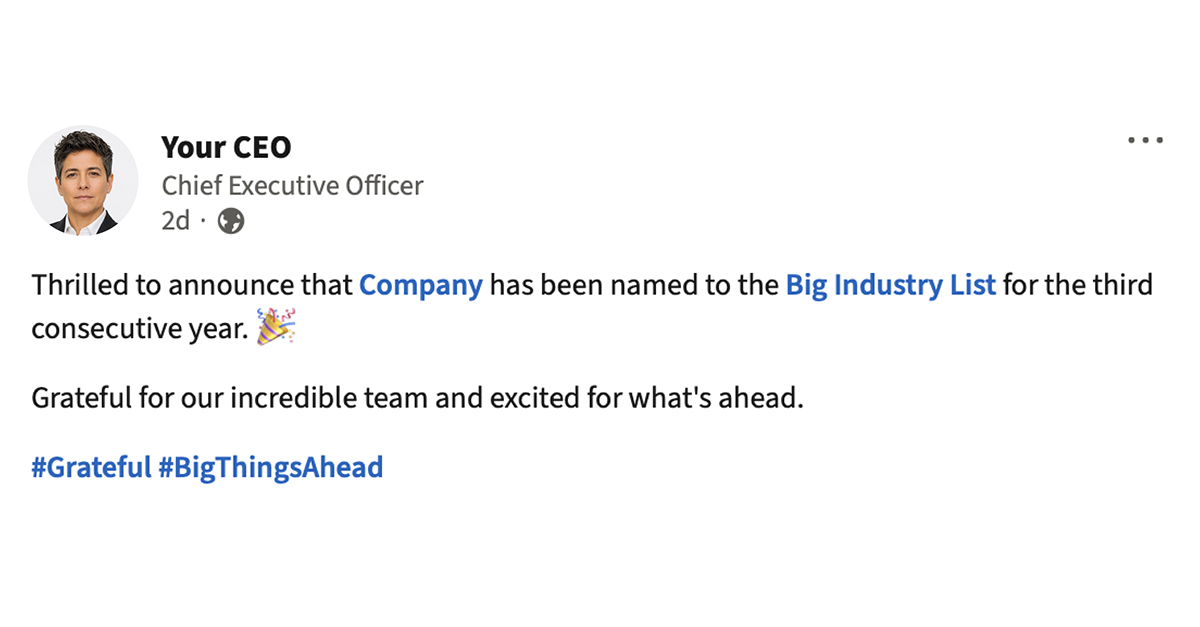
You've seen the post. You may have even written it.
"Thrilled to announce that Company has been named to the Big Industry List for the third consecutive year. Grateful for our incredible team and excited for what's ahead."
It gets a handful of likes. A few comments, mostly from employees. The occasional "Congrats" or 👏 emoji.
At a glance, it reads like thought leadership. It isn't.
How We Got Here
The data backs it up, and every marketing team worth its salt got the memo: personal accounts outperform company pages on LinkedIn. Engagement is higher, reach is broader, and the algorithm simply rewards people over logos. So the directive came down from leadership, as it inevitably does, to get the CEO to post on LinkedIn.
And most companies stopped right there. They nailed the cadence, built a content calendar, maybe even hired a ghostwriter. But no one answered the most important question: What does this person have to say that no one else is saying?
Without that answer, you end up with a LinkedIn presence that's active but empty. And if you're asking yourself, "Can anyone tell the difference? Does it matter?"—they can, and it does.
Three Flavors of CEO Content That Go Nowhere (Spoiler: They're All Vanilla)
We see this across industries, company sizes, and executive titles. The content tends to fall into three buckets, and none of them do what they're supposed to do.
The press release with a headshot
This is the company announcement repackaged as a personal post—a new partnership, an award, a product launch, all delivered in first person with a conference-lanyard photo attached. It's not wrong, exactly. But it's not thought leadership. It's corporate news in a thin disguise.
The safe industry take
"AI is going to change everything." "The future of healthcare is digital." "Companies that invest in their people will win." Fine. But what, specifically, does this executive believe about how it's going to change, what "digital" means for their customers, which investments matter and which don't? Without specifics, these posts could be attributed to any leader in any adjacent industry.
The motivational post with no business connection
"The best leaders listen." "Failure is just a stepping stone to success." "You miss 100% of the shots you don't take," attributed, inevitably, to Wayne Gretzky via Michael Scott. These get likes. They do not build authority. They signal a personal brand that looks like a poster pulled from a dentist's office wall or the Scholastic Book Fair. You know the one.
All three create visibility without building credibility, and they share the same bland taste.
More Posts Won't Fix a Missing POV
Most executive LinkedIn strategies skip the foundational step entirely.
Before the CEO writes a single post—before they even open a Google Doc—they need to answer a fundamental question: What do I believe about the industry that's specific, informed, and potentially controversial? Not what the company believes.
Not what the marketing deck says. What do I, as an individual, think about where the industry is headed, what's broken, and what everyone else is getting wrong?
If the CEO doesn't have a clear perspective that's distinct from the company's marketing copy, the content will always feel like warmed-over corporate messaging—because that's essentially what it is.
We talk a lot at Hencove about the idea that all marketing is H2H (human to human). This might be the purest example. People don't follow a CEO's LinkedIn for company updates; they have the company page for that. They follow because they're placing a quiet bet that this person sees something they don't yet—and that sticking around will make them sharper about their own industry and their own blind spots. Most CEO content breaks that promise within three posts.
What Thought Leadership Sounds Like When It's Working
The Generic Take vs. True Thought Leadership
Why Real Thought Leadership Feels So Uncomfortable
Thought leadership that works requires saying something not everyone will agree with—and that's terrifying when legal wants to review every post, the board might raise an eyebrow, and a competitor could screenshot it. But safe content doesn't build trust. It builds a feed people scroll past.
The executives who break through are the ones who are ready to be specific, stake a claim, and operate in the space between "controversial for the sake of it" and "willing to take a clear position on something that matters." Most executives mistake that discomfort for a sign that they've gone too far, when it's usually a sign that they've finally said something worth reading.
Start with the Person, Not the Platform
A ghostwriter, an agency, an internal content team—all of these can help an executive show up consistently on LinkedIn. But none of it works without access to the person behind the title. And by access, we mean regular, candid conversations where the good material surfaces.
We learned this firsthand working with a company founder who, during one of our check-ins, told us about a business trip where his flight was canceled. Instead of rebooking, he rented a car with colleagues and drove 10 hours to make the meeting. It was an offhand story, but buried in it was a clearer picture of who he is than anything we could have pulled from a press release or company bio.
That story became one of his best-performing posts, and we didn't manufacture any of it. We were simply in the room when he told it, recognized what it was, and helped shape it into something worth sharing.
That's the part most companies skip. They jump straight to content calendars and ghostwriters who can mimic the CEO's voice, when the real work is getting the executive to carve out time, open up about what they actually think, and trust the process enough to let someone help them say it well.
It's a commitment, and not every CEO is willing to make it. But the ones who do stop posting corporate news in first person. Their content finally reads like thought leadership—and that's what builds real authority.
Not sure what your CEO's point of view is, or how to turn it into content that resonates? Hencove helps companies figure out what their leaders have to say, not just how often to say it. Let's talk.