
The Employee Funnel: From Awareness to Retention

It's 9 a.m. on a new hire's first day. They're at their desk, coffee in hand, and there's nothing to log in to. The last message they got from their new employer was the signed offer letter, weeks ago. They don't know which tools to use, who to ask for help, or what to do first. After refreshing their inbox a couple dozen times, they finally get a note at 9:20, sent to their personal email: "Sit tight, more info to follow." By 9:30, they're wondering if they made the right call.
We've heard versions of this story more than once, and it's never one we want a Hencove hire to tell. No team sets out to start a relationship this way, but it happens more than you might think. As marketers, we'd never run a campaign like this. On launch day, the ad goes live and the landing page loads seamlessly because weeks, sometimes quarters, of planning happened behind the scenes. Hiring deserves the same planning. Without it, the relationship stalls at the signature.
At Hencove, we put real care into how people join our team. When we recently welcomed a new team member, we took the chance to fine-tune our process the same way we'd optimize a campaign, with the candidate as one of our most important audiences. Here's how the marketing funnel maps to the employee journey and why we think onboarding starts at the signature.
Awareness: Your Job Post Is an Ad
Marketers know it often takes multiple touchpoints to convert a prospect. For a candidate, the job post may be the first one. It's the sales pitch, and we want it to reach people whose qualifications match what we need. In marketing, that's our ideal customer profile (ICP). When hiring, it's our ideal hiring profile (IHP).
Like any ICP, an IHP can take a few passes to get right, and it starts with a mindset B2B buyers already know. When a company vets a product, it isn't looking for the best product on the market. It's looking for the best fit: one that works with its existing systems and tech integrations and fits its timeline and budget. We approach hiring the same way. The goal isn't to hire the best person in the abstract. It's to hire the best fit for the role and the team. Depending on who's already on board, that might mean someone with more experience or less. In our world, it might mean a strong writer, a natural project manager, or someone who shines in client engagement. We look at the current mix of our team and build the profile around the strengths that will complement and amplify the people already here.
At Hencove, the hiring team weighs in on the profile, and we're deliberate about the skills and level of experience we list so the right candidate can recognize themselves in the role.
Job posts make claims, and any smart candidate is going to do their homework to verify them. They check your website and social platforms, and they might read reviews on Glassdoor or other third-party sites. In our recent blog post, "Why Proof Matters More Than Promises," we discuss why claims only land when there is evidence to back them up. Your brand matters to hiring prospects as much as it does to customers. Do your core principles align with theirs? Are you worth their time and effort? A customer asks whether their dollars are well spent. A candidate will ask the same about their time.
Consideration: Interviews Run Both Ways
Applying takes effort. Candidates dig deeper into your company and tailor their resume and cover letter to show they match your IHP. Interviews are a chance for both sides to check the fit. They're a deeper, more formal touchpoint to sell your brand and convert a promising lead.
As candidates move down the path, they meet different stakeholders: HR, the hiring manager, potential colleagues, and leadership. Each brings value and perspective, and each shows the candidate how the team works. It's much like the experience of a B2B buyer who meets several people on a vendor's team before signing. We want applicants to have a well-rounded experience while respecting their time. The number of rounds varies by role, and in each one, candidates get a chance to ask their own questions. For our most recent opening, we planned for three to four rounds and shared that in the first meeting so candidates knew what to expect. Think of it as a sales process. The first conversation is a friendly 30 minutes, a low-commitment way for both sides to say hello. From there, each round runs longer and goes deeper as candidates meet with hiring managers and leadership. We move to the next round only when the fit feels mutual.
As with any B2B prospect, it's a question of fit, and it's better to find out early. If the fit is there, great. We lean in and see whether it can become a long-term relationship. If something looks misaligned, whether it's salary expectations, experience level, or another factor, we raise it early, talk it through, and are clear about why it will or will not work. Nobody benefits from a drawn-out process that was never going to close.
And when the fit isn't there, the journey doesn't end. Candidates we don't hire are still leads. How you treat them affects your brand, and in B2B, a candidate can later become a teammate, a partner, a client, or a referral source. Don't ghost them. We reply to applicants who email us to let them know what to expect, and anyone we interview hears back from us, even if we decide not to move forward. Many of them stay in our network long after.
The Gap: A Signed Offer Letter Isn't the Finish Line
A signature on the offer letter is the conversion point, and it's where many teams drop the ball. The deal feels closed, attention fades, and the new hire is left in a weeks-long silence before day one.
A conversion deserves a warm welcome, and ours starts with the offer. Along with a written offer, we call our candidates to share the exciting news, welcome them to the team personally, and answer any early questions. Once they sign, we move them into a nurture journey. Here's how we fill the gap from signing to start date:
- Swag: Every new hire gets a welcome gift, timed to arrive shortly after they sign so the excitement carries from candidate to new hire. New hires pick from an online shop we set up, with everything from desk supplies like notebooks to T-shirts, hats, totes, and sweatshirts.
- A nod to life's big moments: Starting a new job is rarely the only big change in someone's life. Two of our team members got married right before they started, and another joined right after graduating from college. Each time, we sent a small gift to celebrate. It's a simple gesture, but it shows we see the whole person, not just the new hire.
- A welcome email from operations: It covers tech and systems logistics. We keep it separate so the details don't crowd out the warmth of the hiring manager's note.
- A follow-up welcome note from the hiring manager: This second, friendly touchpoint directly from the hiring manager that outlines what to expect on day one.
We've built these steps into our process so every new hire gets the same strong start.
Day One: Where Loyalty Starts
When tech is in hand and expectations are set, a new hire arrives energized, organized, and ready. You've taken out the guesswork and built some rapport before they ever open their new equipment for that first onboarding session. Here are three parts of our day-one playbook we've fine-tuned so they work for any new hire, whatever the role:
- An onboarding project plan with prescheduled sessions: Think of it as the campaign brief for a new hire's first weeks. We build a shared board in monday.com that covers everything from meetings and ramp-up tasks to a list of every platform they need access to. New hires know what's expected and can check off tasks as they go. The same structure works across roles.
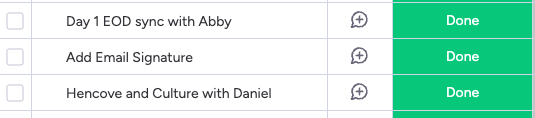
- Coffee chats: New hires have a coffee chat with everyone on the team, which works because we're small. At a larger company, start with the key people a new hire should meet. This matters even more in a remote-first organization, where in-person meetups are rare and getting to know colleagues takes intention.
- Fixed check-ins: They're tied to the project plan and built for accountability. We hold a check-in around the 30-, 60-, and 90-day marks, with a survey as a guide for each conversation, and they don't get skipped when things get busy. Weekly 1:1s fill in the time between and continue well past onboarding, so questions don't wait for a formal review.
Creating Stickiness After Day One: Early Wins and a Feedback Loop
Loyalty keeps building in the weeks after day one. After the first few days, assign a project that gives your new hire a real feel for the role and a chance to contribute without overwhelming them. That's an early win. It looks different by role. For a writer, it might be a first draft of a blog post. For a designer, a social graphic. For a project manager, running an internal kickoff. Then, keep the rhythm going with check-ins at 30, 60, and 90 days, each with clear goals and next steps.
Use those conversations as a feedback loop too. What landed, and what didn't? What you learn improves the next candidate's journey and helps you keep attracting high-quality people. The loop shouldn't close after 90 days, either. Every year, our team completes an employee experience survey that gives each person a chance to tell us how things are going, how they fit on the team, and what we could do better. Marketers don't stop listening to customers after the sale, and we don't stop listening to our team after onboarding.
Hiring deserves the same measurement. Track offer acceptance and retention at one year and beyond, and treat early attrition as churn: it shows where your funnel leaks. Segmentation applies to hiring too. Keep the structure but tailor the content: a senior hire and an entry-level hire need different journeys, so build yours around your ideal hiring profile.
Over time, loyal employees become advocates. They refer great talent and help new teammates settle in. That kind of loyalty takes more than a paycheck. Culture, collaboration, and open feedback all matter, along with fair benefits, flexibility, and a healthy balance between work and life. The goal is to create a team where the "Sunday scaries" don't exist.
Where to Start
If you already build funnels for your customers, you have most of what you need to build one for your next hire. Start with four steps:
- Map the journey. List every touchpoint from the job post through day 90.
- Plan the gap. Schedule contact between the signed offer and the first day.
- Structure day one. Pair a project plan with team introductions and fixed check-ins.
- Measure and listen. Track offer acceptance and retention, ask each new hire what landed, and keep asking with a regular team survey.
Your newest hire is one of your most important audiences. Without great people, you can't reach your ICP or deliver on the promises your marketing makes. So, treat the first weeks like the campaign they are, and make sure the laptop arrives before launch day.
Building or growing your in-house marketing team? We work alongside internal teams as an extra bench of senior strategists and creatives. Let's talk.