
Why Proof Matters More Than Promises: Four Ways to Build Trust With Your Marketing
Every brand wants to stand out, which is why so many companies describe themselves as innovative, trusted, customer focused, or industry leading. The problem is that these claims have become so common that they barely register with today’s B2B buyers. When every company says it’s the best choice, the words stop meaning anything.
How buyers check those claims has changed, too. In TrustRadius’s 2026 B2B Buying Disconnect report, 63% of technology buyers said they used AI during their purchase journey, and 94% of those buyers said they fact-check what AI tells them at least some of the time. Buyers are forming a first impression of your company from AI summaries, then looking for evidence to confirm it. Vague adjectives give them nothing to confirm, but specific numbers, named customers, and published results do.
That doesn’t mean descriptive language has no place in your marketing. Strong, confident copy still earns attention and gives buyers a reason to keep reading. However, B2B decisions are rarely made by one person, and your champion will likely need to defend their recommendation to a manager, procurement team, or executive, and evidence gives them something they can defend.
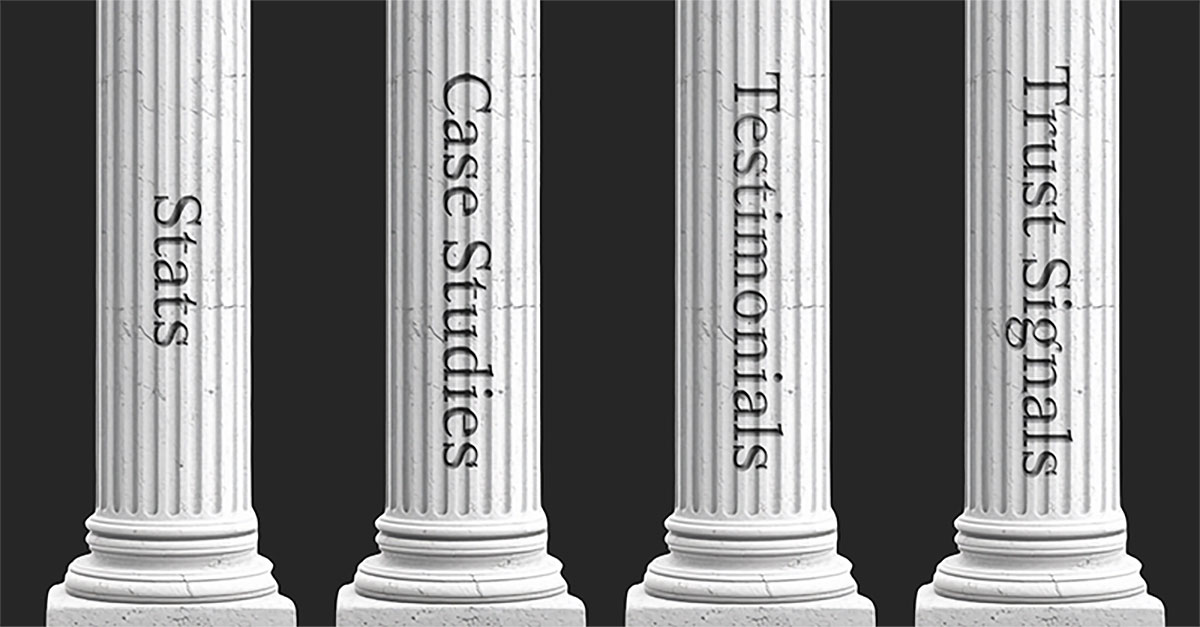
Here are four ways to build that proof.
1. Stats: The Shortcut to Credibility
Numbers are one of the quickest ways to build credibility because they give buyers something concrete to hold onto. A reader may skim past a paragraph explaining your approach, but a specific result registers immediately. It’s easy to understand, easy to remember, and easy to repeat.
Here’s an example from our own work. Hencove serves as the outsourced marketing department for DGT Associates, a Boston-based land surveying and subsurface utility engineering firm. In 2024, DGT’s LinkedIn ads delivered 52% more impressions and 73% more clicks than the year before, while cost per click dropped 40%. Newsletter open rates rose 39%, and DGT claimed the top Google spot for searches like “Surveyors Boston” and “Radar Tomography.” Saying “we grew DGT’s digital presence” is a claim. Those numbers are proof.
Not every statistic serves the same purpose, though. Company-level metrics like years in business or customers served demonstrate stability, which matters when a purchase means a long-term partnership. Outcome metrics answer a different question: What will this do for me? Implementation time, cost savings, retention, and productivity gains connect directly to the results buyers care about most.
The strongest marketing also considers who it’s speaking to. An IT director may care about uptime and efficiency, while a finance leader is looking for cost savings and ROI. Tailor your numbers to each audience, and publish them where buyers (and the AI tools they use) can find and quote them, with the baseline and time frame attached so they hold up to scrutiny.
2. Testimonials: Proof with a Name Attached
A good testimonial puts a real person’s name, title, and company behind the statement. That context is what makes it credible. An anonymous line like “This solution changed how we work” could have been written by anyone, including your own marketing team, and buyers discount it accordingly. That skepticism is only growing now that a convincing fake review takes seconds to produce.
B2B buyers are looking for peer validation: proof that someone in a role like theirs, at a company like theirs, made the same decision and it worked out. A quote from a VP of Operations at a similar-sized company in the same industry carries far more weight than one with no attribution. Independent reviews work the same way. The same TrustRadius report found that 74% of buyers use reviews to inform their purchase decisions, so encourage satisfied customers to post on the review sites your buyers already trust.
The catch is that many B2B customers can’t or won’t put their name on a quote, especially in healthcare and financial services. When that happens, attribute by role and organization type (“CFO, regional health system”) and let specific details carry the credibility. Make it easy to say yes: draft the quote from a real conversation, send it for approval, and ask right after a win rather than months later. In regulated industries, check the rules first. Investment advisers, for example, must meet the SEC Marketing Rule’s disclosure requirements for testimonials, and healthcare organizations need patient authorization before sharing a patient’s story.
3. Case Studies: The Whole Story, Backed by Numbers
Case studies are proof in its most complete form, and in B2B they often do more heavy lifting than any other asset. A stat gives you a single number and a testimonial gives you a single voice, but a case study gives a buyer the whole story: the challenge a customer faced, the solution you provided, and the measurable result that followed. That full narrative matters because the person reading it is often building the case they’ll bring to their own leadership.
The metrics make or break it. A case study that says a customer was “very happy with the results” is really a testimonial. A strong case study shows the specific improvement (a revenue increase, a cost reduction, a faster time to close) and the progression from where the customer started to where they ended up.
One of our health tech clients shows how much a case study can do, even without naming the customer. Their one-page case study about a full-risk group never identifies the organization. Instead, every claim carries a number: 20,000 patients, a 70% cut in risk adjustment infrastructure costs (from $2 million to $600,000), more than 2,000 potential documentation gaps flagged ahead of audits, and 85% of surfaced documentation opportunities accepted by the group’s providers. Leaving out the name didn’t weaken the story, because the specifics did the work.
Presentation matters, too. A case study that’s cleanly designed, easy to skim, and treated like a finished piece of content signals that you take the work seriously and gives your champion something they’re comfortable forwarding. Once it’s published, put it to work: pull its strongest numbers into your website, sales decks, and social posts so the proof shows up wherever buyers are looking.
4. Trust Signals: The Quiet Credibility Builders
Trust signals are the smaller, quieter forms of proof that reinforce everything else, and they carry particular weight in B2B because vendor vetting is often a formal part of the process. Customer logos, awards, industry recognition, and independent ratings don’t tell a full story on their own, but together they build a sense of legitimacy. A row of recognizable logos tells a buyer that other credible organizations have already vetted you.
In regulated industries, certifications can decide whether you make the shortlist at all. Healthcare buyers look for HIPAA compliance and HITRUST certification, and technology buyers expect a SOC 2 report. If you have them, don’t bury them in a footer. Make them easy to find wherever buyers start their evaluation.
Finally, consider letting buyers test your claims for themselves. An ROI calculator does more than describe potential savings. It invites a buyer to plug in their own numbers and see the outcome, giving them a head start on the business case before they ever talk to sales. That kind of transparency is its own form of proof, because it shows you’re confident enough in your value to let the buyer verify it.
Show, Don’t Tell
None of this means you should strip the personality out of your marketing. Confident, well-crafted language is still what draws attention and makes a brand memorable. But in B2B, language on its own is a promise, and today’s buyers check promises before they act on them.
Stats, testimonials, case studies, and trust signals turn words like “innovative” and “industry leading” into claims a buyer can verify, repeat, and defend. The strongest B2B marketing doesn’t rely on great copy or proof alone. It combines both: copy that earns attention and proof that earns trust.
Most companies have more proof than they realize: results buried in client reports, praise sitting in email threads, wins nobody ever wrote up. If you’re not sure where yours is hiding, the Hencove team can help you find it and put it to work.