
Reading Past the AI Layer
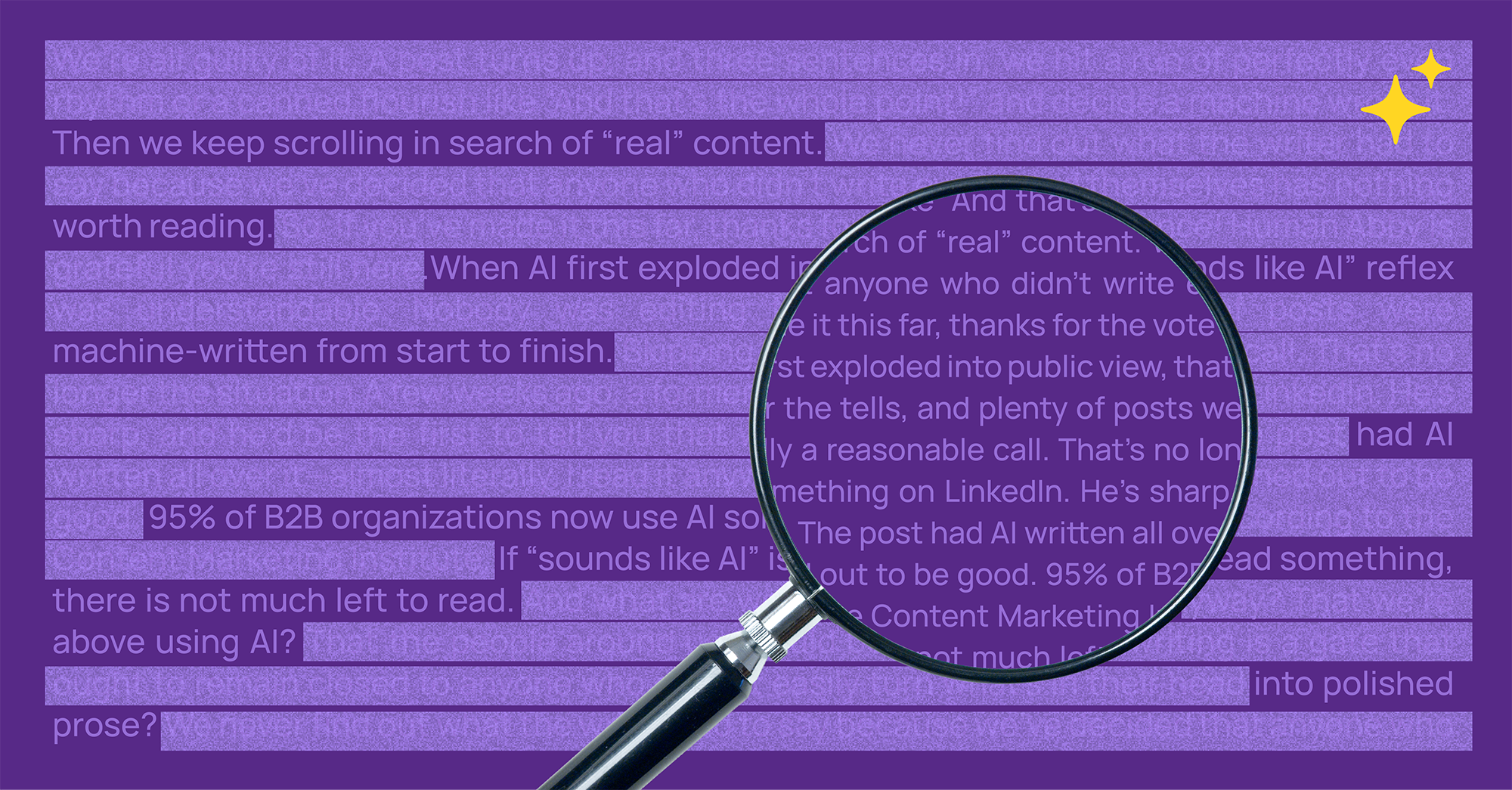
We’re all guilty of it. A post turns up, and three sentences in, we hit a run of perfectly even rhythm or a canned flourish like “And that’s the whole point!” and decide a machine wrote it. Then we keep scrolling in search of “real” content.
We never find out what the writer had to say because we’ve decided that anyone who didn’t write every word themselves has nothing worth reading. So, if you’ve made it this far, thanks for the vote of confidence! Human Abby is grateful you’re still here.
When AI first exploded into public view, that “sounds like AI” reflex was understandable. Nobody was editing for the tells, and plenty of posts were machine-written from start to finish. Skipping them was usually a reasonable call.
That’s no longer the situation.
A few weeks ago, a former colleague posted something on LinkedIn. He’s sharp, and he’d be the first to tell you that writing is not his strong suit. The post had AI written all over it—almost literally. I read it anyway because I knew him, and it turned out to be good. He connected a personal story to an idea that a lot of people in my network would benefit from hearing. I also know plenty of them scrolled right past it.
The Golf Cart Argument
This is not the first time a machine has been accused of doing someone’s thinking for them.
In the spring of 1986, a high school math teacher from Ohio traveled to Washington to protest the calculator. She told a reporter she wanted kids to learn to walk before they spent all day riding around in golf carts. She was not alone. Teachers across the country shared her concern, and school districts wrote rules keeping calculators out of early-grade classrooms. As late as 1990, nearly half of American fourth graders had never been allowed to use one in class.
The worried teachers and parents lost that argument. It took a long time, but calculators eventually made their way into classrooms as it became clear that the tool did not erase the difference between students who understood the math and students who were guessing.
A century earlier, a similar debate played out in photography. Because a machine made the picture, many people argued that there was no artist behind it. It took a Supreme Court case to help settle the question. Not everyone with an iPhone is Dorothea Lange, of course. But today, we recognize photography as an art form worthy of our attention. The purists lost that debate, too.
What Are We Trying to Prove?
95% of B2B organizations now use AI somewhere in their marketing, according to the Content Marketing Institute. If “sounds like AI” is enough of a reason not to read something, there is not much left to read.
And what are we proving with that filter, anyway? That we’re above using AI? That the people around us should be above it? That writing is a gate that ought to remain closed to anyone who cannot easily turn what’s in their head into polished prose?
Some of the sharpest people we work with don’t enjoy writing. They know things about their businesses that took years to learn, and they would much rather explain those things out loud than sit down and shape them into paragraphs. So they use a tool to get their ideas onto the page. The thinking is still theirs.
A Better Test: Is There a Person in Here?
That leaves a different question: what should we screen for instead?
Style is the wrong place to look because style is often the part the machine changes. What AI can’t manufacture is a real stake in the subject. Instead of asking whether something “sounds like AI,” we should ask two questions. A post needs to answer at least one of them well.
Is there something here we could disagree with? Nobody has ever taken the other side of “culture matters.” But saying you ungated your content and increased qualified leads is a position that smart marketers will have strong feelings about.
Is there something here that only this person could have written? Usually, that means a number from their own business, something a customer told them, or a pattern they can see from where they sit that nobody else can see.
That doesn’t mean there’s no such thing as slop. There absolutely is. But slop is what happens when machines do the writing and the thinking. It’s cotton content candy: it looks great, but it’s gone the second you touch it. Tuning that out is completely reasonable.
The Work on Our End
The responsibility doesn’t fall only on the reader. Asking people to give a post the benefit of the doubt creates an obligation for whoever wrote it: to make sure the person survives the process.
That’s a lot of what we do at Hencove. Somebody hands us a long interview or a rough first draft, and we find the real idea inside it. We help shape it, clarify it, and make it readable, but the underlying thinking hasn’t changed.
Like the kids in Ohio, we just have new tools—and perhaps a bit more to prove.
The fourth graders who weren’t allowed near a calculator in 1986 are pushing 50 now. Some of them are the ones posting. The objection waiting for them is the same one, just aimed at a different machine.